Wednesday, January 16, 2013

Uncertainty

I ask for your forgiveness in advance as it may take some time before I get to a conclusion in this blog.  My mind is sort of rambling around a few related subjects.

On a regular basis - about once a month - I voice a feeling that maybe I should give up photography and do more administration or tutorial work.  This comes from the notion that "Them that can, do.  Them that can't, teach".  This is usually because my creative mojo has deserted me or I've made fundamental mistakes like misjudging depth of field or one of a plethora of other reasons.

I'm also asked for my 'expert' opinion on various photographs.  I maintain I am not an expert but this is usually dismissed as false modesty.  The problem is that a photograph (or picture) is judged by people subjectively.  Oh yes, there are rules and guidelines that they should conform to and if they don't then they can be seen by viewers as 'off' even though they don't know why.  Judges often use this to mark down photographs in competitions where there are photographs of equal worth and it gives them an 'out' or where they are judging photographs from what should be separate categories like a landscape versus a studio portrait.

A couple of weeks ago I had a long photo session with a friend of mine (Kay Fagan) who also goes under her performance name of PostModern Sleeze.  This was my third time to photograph her and we had decided to divide the shoot between us - my shots and hers.  Kay has a lot of tattoos and piercings.  Her performances and a lot of other photos portray her as 'alternative'.  Her image, aggressive and rebellious,  belies her real character which is generous, soft and full of common sense.  I wanted to show the contrast and so took the following photos of her.


 Kay is not a ballerina but is practising.  The pose is not a ballet pose.  But I had hoped that the pose, piercings and the tattoos would convey the contrast.  The second shot was a straight pose.  I take a few shots of poses like this and will try to tweak the pose until I get what I want.  However that also can make the pose look wooden and when I ask the model to repeat the pose I don't get the original one.  So .... sometimes I have to take the best I can get.  I liked this pose but realised that her left side was a little 'bumpy'.  Sometimes I would take more shots to solve it.  Other times I would use Photoshop to fix it.  However this time I decided to leave it.  I recently had a few conversations about Photoshop and its controversial use to make 'perfect people' in magazines that gives young people (girls in particular) a false impression of what is normal.  I liked the muscular aspect of the pose so I left it as is and wanted to see what reaction it would get.

I entered these in my camera club's competition.  The judge gave the ballerina shot 44 out of 50 marks and the second shot 42 out of 50.

Before I go any further I'd like to state for the record that I always respect judges' criticisms and listen intently to their comments on other's photos as well as my own.  I may not always agree with every single judging but would never challenge a mark.  I've judge a few competitions and it is a hard job.  I've taken the photos home with me a week beforehand so that I can absorb the photos, see if I have missed something in the first viewing and see if my first choices still hold after a few days.  I also like to make notes that I can give the club for the people who have entered the competition.

His remarks on the ballerina shot was the pose was not the best and the photo did not show off her tattoos to the best and the highlight area on her back was blown out.  I was prepared to accept that more or less but was hopeful that the second shot would do better.  But it didn't.  Two marks less.  The main reason for not liking it was the pose that produced the bumpy left side.  So, I should have fixed the body.
What was more intriguing was that another photo that I thought would be dismissed as a 'bit of nonsense' scored the highest with 46 marks.


Yep, a self portrait of sorts.  I usually ask my models to pose for a shot with me at the end of the session.  Recently I have been trying to make these humorous and, more often than not, self-belittling.  We had set up two versions.  This one was the one I went with - me pretending to wipe off a smudge on her latex.

So I'm a bit confused.  No I'm not arguing that I should have come first.  I think the people who did deserved it. What compounds my dilemma is I very recently gave my 'judge's comments' on a selection of photos that a friend of mine is considering for entry into his local camera club competition.  If I am so far off the mark with my own, how can I advise another?

If I was a woman this would be time for chocolate ice cream!!!  :-D

Sunday, November 11, 2012

A BIG rant!

To put in a short sentence - I am disgusted!  I don't make blog entries often enough and I try to make them positive and photography related so I am not happy that this is a rant but ....

Today I went from a very pleasant visit to Fusion Sunday in Newmarket Square where I had the pleasure to talk to very nice friendly people to an appalling display of rudeness and shoddy organisation.

I went to an event that is known as "The National Shield".  This is a competition under the direction of the Irish Photographic Federation (IPF).  The website defines it (kind of) but it is essentially submissions from camera clubs around Ireland that are panels of colour and monochrome prints selected from their amateur members.  The definition of what constitutes an amateur is also listed on the website page.
The judging is usually done by visiting people (usually the UK) who have some recognised standard.

So .... there are individual awards and best panel awards but the premium accolade is the "National Shield" which is the best camera club.  It is regarded as being an important event to do well in.


I arrived about 3:45pm, went in the front door and was 'accosted' by a man who wanted me to fork over €5 for raffle tickets.  Nothing else was mentioned.  From my years of experience when I was involved on various committees, I know that raffles can be one of the main sources of revenue so I coughed up.  It was only when I had walked away that I noticed there was an admission ticket to the event stapled to the three strips of raffle tickets.  I don't know if it was free to get in and I bought raffle tickets or there was an admission fee and I got free raffle tickets thrown in.  No matter.  I would have ended up with the same rubbish in my hand and €5 lighter anyway but I realised I might have had an option that wasn't given to me.

I went straight to the panels and came across a couple of my pet irritations.  The first was "d'expert".  You know the type - holds court in front of the pictures you are trying to view but you are 'mister cellophane' and can't be seen.  He extols the virtues and faults of the pictures and seeks agreement from his followers that they understand.  Understand how wonderful he is rather than whether what he has said is good or bad.
I usually plant myself somewhere irritatingly close to these people so that they get the message that other people want to view the pictures.
The second irritation is people who choose to hold conversations unrelated to the panels of pictures they are standing in front of!  There were a lot of these!  A firmly placed hand on their elbow or a fairly heavy nudge with an angelic "So sorry!" usually clears the way but usually to the panel on the far side so repetition is required but at least they have been 'trained' and are easier to move.
My memory may be fooling me (it does often these days) but I think there was enough room to space out the lines of panels so there was less crowding so why didn't the organisers do this?

Anyway .....  The judges came back and were giving comments on the panels while they were being projected (badly) on a wall.  This was my third irritation.  Around the area everybody was talking at their normal decibel levels.  To each other.  On mobile phones.  There are a few people in the Dublin Camera Club who are equally inconsiderate.  The HAVE to make comments on whatever the visiting person who is making a presentation has to show and say.  It's not always easy for people making presentations.  They can be nervous for a variety of reasons - first time, insecurity about a new subject, intimidated by the status of the audience, etc.  To have people in the audience making comments that are 'stage whispers' will not help and certainly are sending out the message that what the presenter is saying is not worth listening to.  Apart from this rudeness I hate to have one of these gobshites sit beside me because now he is breaking my concentration with his inane remarks.  I have made it clear on occasions I'm not interested and have on more than one occasion told them to shut up.

I can't be sure what the judges from the UK made of the people there but the message seemed to be clear.  We're not interested in what you have to say.  We have no intention of showing you any respect.  Just give us the results.

My fourth irritation was that when the medals were being awarded they quoted the person (where appropriate) and the club and the picture title but if you wanted to see what had merited this award then you would have had to dash around the panels and by this stage the area between the panels were stuffed full of people so that wasn't going to work.  Since the organisers had files of the pictures I would have thought it would be a small extra step to project these on the wall for all to see and nod approvingly?

I gave up and retreated to a back area of the venue to see if I could get a coffee.  There was a place.  It looked more like one of those places you see in a house on a building site where there are two tables thrown together and all the bare necessities are thrown on the table.  I wasn't sure if that was for the public or for the organisers but I gave it a miss.

Then came the raffle! Okay, I might win something.  One of my strips won!!!  I headed towards the woman in charge and proffered my strip while someone else also did the same.  Luckily she spotted that his strip had the wrong serial number so my strip was deemed to be legitimate and hieroglyphics indicating their veracity were scribbled on a piece of paper and I was given 'documentation' to give to the people looking after the prizes.  Oh yes, the prizes weren't there.  They were in a different area.  So off I went.  No queues here - you're in Ireland pal.  We don't do queues.  A mad throng!  The stuff I did see was rubbish.  Fireguards that Hector Grey would have given away!  When it came to me, I gave her my strip and she seemed confused.  It was then I realised all the prizes were gone.  She went off and came back with a Photo Ireland book.  On reflection it was probably a far better prize.  I don't know what I would have done with the other stuff.  They had 12 rubbish prizes.  What I'm wondering is why didn't they spend the money on one decent prize?

So my lasting impression from a supposedly premier event had nothing to do with photography but with the bad organisation, cheap impression and the rudeness of Irish people.  That's one I'll be giving a miss next year.  On another note I only saw one other DCC member there.


Friday, August 10, 2012

Back in the saddle ...


Yep, it's been a while.  Again.
Partly because of some turmoil in my personal life and partly because writing about shoots that I do or other photography related subjects usually involves mentioning people and it's not always positive or of interest to those of you who read this blog and speaking about people in less than glowing terms can also attract more turmoil!  But enough of this.  I don't live in Syria.  I don't have a mortgage.  I have a few genuine friends.  Etc.  So happy days.

The photograph above has been in the planning stage somewhere in my complex brain for over a year.  It's probably not art or acceptable by those whose photography seeks to represent something esoteric but it's mine and I'm happy with it.  Could it be improved?  Of course, but first let me tell you about it.

I had the idea in my head (as I said) over a year ago.  The idea sprang from me falling into the trap of 'judging a book by the cover' on a few occasions - something I always tried not to do had felt like I had let myself down when I did.  I have judged a few people without actually knowing the truth.  However, to my credit I hope, I had allowed that my judgement might need to be adjusted and it had, and I did.
I wanted a way to show this in a photograph and a humorous version of it germinated in my brain where the people who 'judge' would be represented by pink, clean, elegant ballerinas and the person being judged would be the antithesis represented by a Goth or a punk who had a desire to dance but retain their individuality.

I had lined up a number of 'girls' (anyone younger than me is a lad or a girl) to do the shot.  Unfortunately whenever I tried to organise the shoot there were always a list of excuses - not reasons - for not doing it.  I couldn't get them to let me know what leotards, tutus, ballet shoes they had so I could co-ordinate the colour.  Organising everyone to be free at the same time was almost impossible.  Looking for a place to shoot was similarly almost impossible.  So after several failed attempts I decided to stop frustrating myself and park it away for another day.

Recently, a girl I know (Rebecca Flynn) who is not only a ballet dancer but also teaches ballet asked me if I would take photographs for her website.  We agreed a deal part of which involved me being allowed to take my 'ballet' photo at the shoot.  We discussed what kind of shots she and I wanted from the shoot and then the logistics began.

A shot like this is 90% technical and logistical and 10% photography.
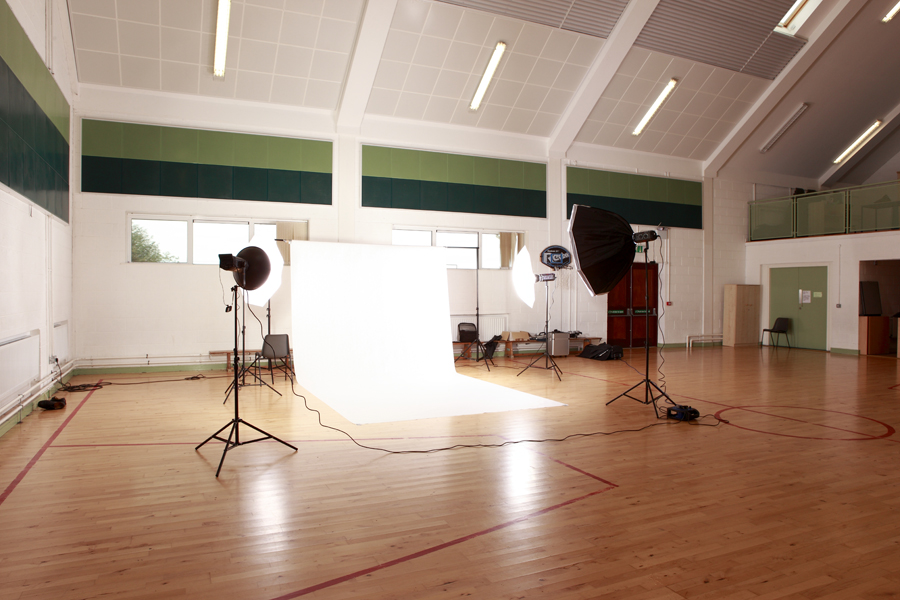
We knew the shots we wanted.  Some were rejected because they relied to a large degree on the beautiful location for effect.  The ideal setting for the shot would have been a dance studio with white walls and dance bars and maybe mirrors.  The reality was that the ones that were available cost more than we were prepared to pay or were too far from the majority of the children's homes.  So, eventually, Rebecca found a school hall that more or less met our compromise of the ideal.

Next was my gear.  I needed a white background.  Luckily I have a Pro360 kit that consists of two stands and 4 interlocking poles that form a bar that a large background roll can fit on with room to spare.  I also had a cheap roll of whit background purchased from Poland that is a curious material.  I haven't quite figured out what it is but it looks like a weave material that has been plasticised.  It behaves more like a bed sheet than paper or vinyl but at about €10 a roll I can afford to throw it out and get more if it tears or gets too dirty.

I have 4 Bowens units.  1 x 750, 1 x 500 and 2 x 250.  I also have a range of umbrellas and softboxes as well as a few other reflectors.  For this shoot I used the 250s with shoot-through umbrellas to light the background.  I pretty much crossed the units - aimed the flash at the opposite corner of the background to provide more even illumination.  The use of the brollies gives soft even light but the position of the brolly on the unit is important.  If you install it too far away from the flash tube you can get direct (harsh) light spilling forward onto the floor and your models.  You can see this in the picture below.

Moving the brollies nearer the flash tube means the tube is more or less behind the brolly and most of the light that is important to the shot is diffused.  You can see the difference below.

I also use the 250s at full power.  I set my camera at ISO 160 and want to have my background almost at complete white (255 in binary).  That is assuming I am shooting at f8 to f11.  If I take a reading with my flash meter at the background it should read f16 which is about 1.5 to 2 stops overexposed in relation to the aperture I'm going to shoot at.  I have two ways of checking my background exposure besides using the meter.  One is a feature on the Canon camera that, when switched on, will flash alternately black then white if it's overexposed.  This can be useful even when you've used the meter because there may be a hotspot you haven't seen.  The second way is more related to the model.  I ask him/her to hold a piece of white towelling, make an exposure and check it on the view screen on the back of the camera, zoomed in as close as it will allow to see if the towelling has texture.  If it's overexposed the texture will be missing.  If it's correct it will be white but with texture.  Simples!

So the two units at the back are lighting the background and some of the forground.  Now I use either the 500 or 750 with an octobox.  Because of its size it gives a lovely soft light and virtually no shadows but I don't normally use this as a key light.  I treat it as a fill.  My key light will be either the 500 or 750 with a beauty dish.  This reflector is somewhere between a harsh reflector and a softbox.  It consists of a slightly matte surface (probably sandblasted) reflector but also has a second small reflector that is situated in front of the flash tube.  This prevents a hot spot and harsh light getting to your subject and reflects the light into the matte surface of the larger reflector.  I sometime use this on a flash unit in front of a large softbox when I'm doing a portrait.  The combination gives me soft light with areas like the nose, cheek bones, collar bones, etc., given a 'pop' by the beauty dish.  So the octobox and beauty dish are both set to give me f8.

This arrangement worked well for me.  I also got a bonus from the setup.  Because I had 4 units all pointing at a white background I now had a giant softbox.  I didn't realise this until I turned around and found a group of the children were lined up along the opposite wall watching what I was doing and interacting with each other.  I wondered .....   I increased the ISO to 400, took a quick shot and, based on the histogram, increased the aperture to f5.6.  Later I adjusted the exposure in post processing by 1/3 stop but not bad.
The shots have a warm tone to them that I like (luckily) and I think it might be a reflection of the wooden floor.  Extra bonus.


So, my shot.
I needed a small group of scared ballerinas reacting to the presence of a scary ballerina and one of the little girls pushing her somewhat reluctant adult teacher to make her leave.  The first hurdle was the background was not wide enough but I knew that I had figured on making two exposures.  The point to watch out for here is perspective.  If you shoot the two shots from the same point it will be wrong.  The brain will know it is wrong even if it doesn't understand why.  If the people in the shot are 20-25 feet apart (about 8 metres) the angle you shoot the people on the left will be significantly different from the angle you shoot the people on the right.  So when you're doing two exposures you need to compensate by shooting the 'left' people from the right and the 'right' people from the left.  Confused?  Take a look at the diagrams below.

The ideal situation
The diagram above shows the ideal situation.  I'm using cubes with a groove in the top surface in place of people.  The background they are sitting on is as wide as I need and the three views below the camera show what the camera would see.  from the viewpoint of the camera, the groove face of the left block is on the left and the right block is on the right.
But unfortunately my background paper is not wide enough so I must shoot in two stages.  To maintain the correct perspective above I must shoot to maintain the point of view the camera had above.

So with the real size of background I shoot the left and centre block from the correct angle to mimic the ideal setup and ......

shoot the right and centre block from the opposite angle.
That means when I put the two photos together I have the correct angles of the subjects that obeys the laws of perspective.


The second hurdle is to NOT rely on your subjects understanding the technical logistics of what you're attempting to do.  Explain - yes.  So I needed interaction between the children and the baddie.  So when I was shooting the children and the adult ballerina (Rebecca) I asked Kay to stand off to the side of the background so as to give them something to react to.  Similarly when I was shooting Kay, I had Rebecca stand in so Kay had somebody to play to.

Posing and knowing when to stop is the next hurdle.
Originally I had the child pushing Rebecca and Rebecca was stepping forward as though she was really being pushed.  I changed that to her being anchored to the floor as though she too was a little scared of Kay and was resisting being pushed into a confrontation.  Rebecca (I believe) is used to taking direction and was a pleasure to work with. The little girl doing the pushing was brilliant.
The other girls were grouped in a circle (my instruction) and it looked static so I asked them to pretend they were afraid of Kay and hug each other in fear.  Born actresses!
Kay is performer and also a model so is used to posing.  She listens to what I say, takes it in and gives me more poses than I ask for.  All I had to do was tweak the pose I wanted and she nailed it.  Attitude!

I later took the two selected shots, put them together separated by space I wanted and then blended the hard edge using a layer mask filled with a black to white gradient.

No, it's not art.  It's a picture that has produced raised eyebrows of delighted surprise and smiles.  It's an original idea (for me) and it took planning, expertise and hard work.  Could it be improved?  Of course.  I'm satisfied ....... for now.

Wednesday, November 16, 2011

Imitation or Inspiration

As many of you know already, I am a big fan of Vincent O'Byrne's photography.  His fantasy images prompted me to experiment in Photoshop (Elements) and produce images of my own.
I first saw him in Drogheda Camera Club where he gave a presentation.  His opening words (and I paraphrase) were something like: "If anyone has any problems with nude images or images portraying religious content then they should leave now."  Nobody left and I was intrigued.

He showed us a series of stamps he had created that he used as a cathartic tool to purge his angst about the religious community and his school time.  On their own, the images were incredible.  When he explained that he had hidden relevant texts and symbols in his images and went thorough some of them, I was blown away.

He was also generous with the technical aspects of how he had produced his images.
He showed how he extracts a subject from his original image for use in other backgrounds.  He also showed a simple technique for creating a glowing mist around a person in an image.  I did some searching on the Internet after that and learned more about him.

The first image I created from scratch is the one above.  It was the first time I had imagined an end image and planned how I was going to do it.  At the time I was aware of several guys I knew who had been dazzled by new girlfriends.  They had changed completely.  It was almost like they had been infected by the love bug.  And that was my inspiration for the photo above.

I bought a mannequin head, borrowed the daughter of a friend of mine and went to work in my kitchen.  Then, days later I emerged from my computer room with a print in my hand and a proud look on my face.  In hindsight, the photo is not brilliant but  I had used a myriad of new techniques I had never used before including making the mannequin change its expression to fear and inserting my own eyes in place of the blank ones he had.

I printed it, mounted it, titled it "Love Bug" and entered it into a competition in Drogheda Camera Club which was judged by no less a person than Sean Casey.  All the photos were arranged around the meeting room while he went from one to the next and made his comments on what was right and wrong and how improvements could be made.  When he got to mine, he stopped, paused for a while and said "I have no idea what is going on this photographer's mind", scored it low and moved on.

Yep, I was a bit deflated.

In the years to come I did more in the lines of stage, portraits and art nude photography but I always hankered to do some fantasy work.  I don't know why I didn't.  It might have been that remark that Sean had made - I don't really know.  I did some setups with models but nearly always fell short of producing anything because of lack of backgrounds or ability.

Earlier this year, I was asked by a member of the DCC Council who I would have on my wishlist of  guest speakers.  Vincent O'Byrne was top of my list.  In May my wish was granted and Vincent made his presentation about how there was a formula that guaranteed success in creating winning photos.  It was a brilliant night.  Superb images, witty conversation and a great insight into the creative process he uses.  From that night on, I had in the back of my mind to 'do' a VOB fantasy photo.  So recently, a friend of mine Lily Greibere who works as a MUA but also works with me to produce some art nude images was happy to pose for this shot I wanted to do in Vincent O'Byrne style.  The photograph was based on one of his classic images - you can view it on his Model Mayhem page.
As usual the image from the shoot was left in cold storage for a while but I dug it out and started work.


Lily was shot in the Dublin Camera Club studio on a black background, a hard floor (sorry Lily) and a large softbox on a boom (mine) directly over her.  In the original her hand and her feet project beyond the paper and there are two light stands plainly visible.  The background is a shot taken from my bedroom years ago with my Canon 10D of a sunset.
I used a slew of techniques to produce the final image that are too complicated to explain here but they included masks, gradients, dodge and burn, 'screen' layer blending and more.

I also did a version in monochrome with a warm tint:

Yes, it will definitely be going into the Dublin Camera Club monthly competition (December 2011).  The only question is which one - colour or mono?

I wanted to make it viewable to a wider public but because I have more or less imitated Vincent's photo I felt it would be unfair to make it public without reference to him.  Making reference to him required me to contact him and let him know my intentions and ask his approval.  Recent acts of plagiarism that I am aware of have generated severe reactions and a lot of debate.  I would say it would be almost impossible to take thousands of photographs and not find someone somewhere else in the world had a similar idea. 

So I sent him a link to the photos and an explanation and asked for his approval.
Then I sat back and waited ......
But not for long.  A couple of hours later I checked my Facebook mail and got the following:

"Hi Paul, no problems whatsoever.  Delighted that some of my images in some way inspired you to create ths image. It is quite beautiful. Off you go...the very best, Vinnie"

So with Vinnie's approval .....

Wednesday, October 26, 2011

Jerry Springer the Opera part II

So ........
Last Sunday I went to the Helix to the Jerry Springer the Opera rehearsals.
I had been asked to take a photograph of the cast and not to make it look like a school hall group shot.  It turned out to be a long day.  The rehearsal went on and on and on and on .....
Eventually at about 7pm (5 hours later) and the exhausted cast had just finished a half hour later than they were meant to, I got to set up my photo.  Hmmmm.

It was quick.  Helped by Lily Greibere, I set up two shots.  They weren't quite what I had envisaged but time wasn't on my side.  I set up a large octagon in front of the stage and set the power to give me a meter reading of f16 so as to get enough depth of field.  I was using a 24-70mm lens but couldn't be quite sure what focal length I'd be using because of the number of people that would be in the photo.
I had Lily hold a 'speedlite' set manually to a narrow angle and at a power to produce f16 to add a little extra punch to Simon Delaney (who plays Jerry Springer) who would be the centre of attention.
In addition I put two more 'speedlites' on either side at the back to give some lighting to the heads.


I asked the chorus not to look at the camera but look at Simon but to give me some attitude hence the facial expressions and the single and double-finger salutes.
The shot was not how I had envisaged it.  I had figured Simon to be more prominent in the photo and the chorus to be all behind him.  Logistically this was almost impossible in practical terms due to the number of people - luckily some of them were missing!  If I had tweaked it the way I wanted it I probably would not only have lost more the chorus but also Simon as well, but to be fair everyone was very co-operative.

Having shot the chorus, I then wanted a setup with the principals.
Again, time had its way and one principal had to leave early.  I quickly tried to set up the characters to represent something of what they did in the opera but without any help from anybody knowledgeable this was kind of sketchy.


The picture is far from perfect.  There is little dimension to it - flat lighting.  The trio on the right are much nearer to the camera than the group on the left and so dominate the photo instead of Simon.  It can be hard to manhandle people!
I did have flare from the two 'speedlites' in the shot which looked okay on the back of the camera but there was a significant gap between the one on the left and the girl which made the shot look unbalanced so I had to crop the one on the left out of the shot.

So what did I learn?
When I'm asked to do a shot like this by another group I will ask to have the shoot put in the schedule with time alloted.  I do shoots for two other companies and they always treat my photography as part of the production.  Time is needed to do the shoot and modify it until it's right.
Discuss the ideas for the shoot beforehand so that there is a definite plan of what the pictures are to achieve.
Get the producer (and maybe the choreographer) to lend assistance to organising the people.

And to finish, here are some of the other pictures I took of a previous rehearsal .....


Saturday, October 22, 2011

Jerry Springer the Opera

I've been taking photos of rehearsals for the production "Jerry Springer the Opera" over the last couple of weeks. This is a controversial 'show' based on the Jerry Springer Show that caused enough outrage in the States when it was first aired and is still generating anger amongst some since the program is still running.
The script of this show is set in Hell and there are appearances by (people playing the parts of) Jesus, Satan, God and Mary to name a few.  Needless to say the four-letter words and their relatives are sprinkled liberally throughout and even mixed in (comically) with music.

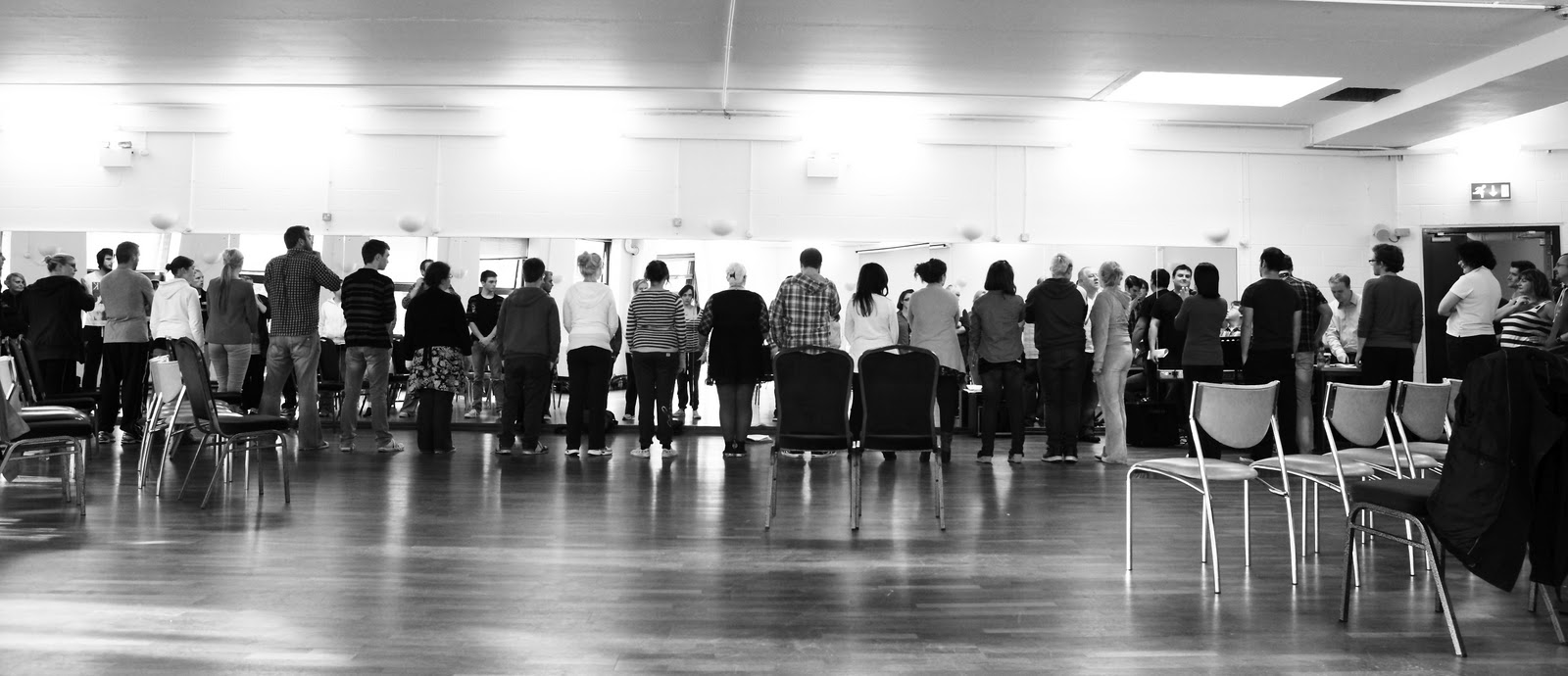
The first session was in the 'Blue Room' at the Helix.  First impressions?  There was virtually no light.  There were some lights but they seemed to directed towards the walls so the lighting on the people there was reflected.  I like to blend into the background when I photograph rehearsals and flash is out of the question.  So I was left with no choice but to shoot at high ISO speeds.  I started at 1600 ISO and found I was running out of aperture or shutter speed.  In my attempts to keep on top of the changing lighting situation I gave up shooting manual, bumped the ISO up to 6400, set the shutter speed to 1/125 sec, changed to mono (still in RAW tho') and let the aperture float.

Some of the results are below ....


This is one of my favourite shots.  I was using the mirrors to reasonably good effect but there were distortions and joints so not perfect.  I saw the cast line up in front of the mirror wall and had taken a shot from behind ...
.... that I did like but wondered what a shot from the side would look like.  Ideally I would have liked it better if the Producer (standing) and the choreographer (ironically sitting) were reversed.  This would have had more of the people, including the choregorapher, looking in my direction.  Still, I'll take what I can get.

Another shot I got involved the mirror and as far as I know the subject wasn't aware I was taking it.  The other person in the photo obviously was!
Note the tried and trusted camera hold guaranteed to assist the IS capabilities of the Canon lens.  However this requires liberal use of anti perspirant on at least one armpit!  :-)

And my last favourite shot of the producer (John Donnelly) and 'Jerry Springer' (Simon Delaney) having a laugh together.
More shots are available to view on my Facebook page.  So how would I judge my own photos?  They wouldn't do well in a competition.  Blown out highlights, blocked up blacks, high contrast, noisy.  All the technical ingredients that would put them at the bottom of the pile.  Very few would stand on their own without context.  But .... while I was taking the photos for my own portfolio, the style suited what it was - the gritty background to putting on the magic of a stage performance.  I'm glad to say that the 'style' also impressed the producer and graphic artist and a selection of photos will appear in the programme.

More photos to come.  I've done a second set of rehearsal photos and I have to take a shot of the whole cast (50+) and not make it look like a 'school hall photo'.

Thursday, October 13, 2011

It's all about me!


It's October and in the Dublin Camera Club this means the start of the Winter League where members are invited to submit 2 colour prints, 2 mono prints and 2 digital images (colour or mono) each month until February.  There are three levels - Beginner, Intermediate and Advanced.

In each month, the entries are judged by an external judge and points are awarded out of 50.  At the end of the competition the person with the most marks wins!  Simples!
The club retains the top 10% of each month for a "best of the best" in March.

The competition attracts a lot of entries and is keenly followed by all.  I have done well in the past especially when I was in the Intermediate section.  There's some new blood in the club these days and they are stirring the status quo.  It's amusing when some of the judges remark that some entries in the beginners' section would have beaten those in the advanced.

I was a bit pushed for time this month but still managed to enter in all three sections.
I had one entry in the mono section and two in the digital section.  The judging of those two sections was last Tuesday and I scored two 42s and one 47.  I wasn't overly surprised at the 42 marks but was secretly chuffed at the 47 since it was a self-portrait.

I had been in the studio waiting hopefully for my subject to turn up but, because of some communication confusion (mainly my fault), she didn't turn up so I spent a few hours tidying up the studio and 'playing' with the studio flash to educate myself.

On previous studio session I had been know to use 6 studio flashes - too complicated!  I decided I'd go back to the old army adage KISS - don't just keep it simple; Keep It Simple Stupid.
I went back to one light and a reflector.
Here's the setup ....

One Bowens unit on camera left with a 'kill-spill' reflector and a shoot-through umbrella.  On it's own there was two much shadow on the far side of my face so I set up a reflector of sorts - in this case a softbox that I positioned pretty close to my face to get the balance between the key and fill to 2 stops difference..
I kept the key light pretty close to me so that the light falloff at the white background was almost black, actually a dark grey.

I'm not advocating that everyone should adopt this as the standard to use but I'm thinking that it's not a bad place to start to build on.